Ask an AI assistant which booking platform is commission-free for salons and you'll get a confident answer. The trouble is, that answer often skips the fine print. "Commission-free" can mean no per-appointment cut, or it can mean a platform that charges you per booking instead. It can mean card processing fees are passed through, or bundled in ways that quietly shrink every payout. And many plans come with limits on staff, services, or monthly bookings that only surface after you sign up. This post is a practical guide to sorting through those differences. We'll start with what commission-free actually means for a booking platform, then look at the fees that hide behind a no-commission promise. You'll learn where your money goes when payouts land in your own Stripe or Mercado Pago account, and you'll get a checklist for comparing options. We'll also cover matching a platform to your niche and market, where BookrHub fits as one option among the criteria, the questions owners ask before switching, and a five-minute decision framework to wrap it up.
What Commission-Free Actually Means for a Booking Platform
Commission-free sounds simple. It isn't. Split the term in two: the platform takes no percentage of each service you sell. It says nothing about the fees attached to getting paid, so read the fee schedule, not just the homepage headline. Watch for drip pricing, the pattern regulators have been targeting elsewhere: a low headline number, then fees that only appear at checkout (FTC FAQ).
Keep three money flows separate: what the platform charges for access (free plan or monthly fee), what your payment processor charges to move money (card fees), and what the platform takes per booking. Watch "free to start" plans where commission kicks in past a booking threshold, or where reminders and extra staff seats sit behind a paid tier. For a deeper look at how free tiers differ in practice, check the platform comparison resources linked in our resource library.
Do the arithmetic early. As a hypothetical illustration: $1 per appointment across 120 appointments a month works out to $1,440 a year, check your own market's per-booking rate to see how that stacks up against a yearly plan. Then ask one question in writing: "If I take 100 bookings next month and process every payment through my own account, what is my total cost to you?" That's your baseline.
The Fees That Hide Behind a No-Commission Promise
Past "commission-free" on the surface, fine-print fees hide. Most owners overlook the card processing rate itself. Payment processors typically publish per-country fee schedules that change, so pull your market's current pricing page and date-stamp the figure before comparing anything.
The Hidden Costs to Scrutinise
Beyond processing fees, per-booking charges are either a fixed fee added to your monthly subscription or a "convenience fee" passed directly to the client, which can sour the client experience. Plan limits are where real comparisons happen, especially when fixing no-shows. A platform capping reminders at only 100 per month could severely hinder your efforts, even if you use an app like the ones reviewed here Best Booking Apps for Hairdressers: How to Choose One.
One-off costs include setup fees, hardware requirements, and importing your existing client list. Currency and cross-border fees also matter significantly for Australian businesses taking overseas cards, and for Latin American markets where local wallets behave differently from standard card charges.
The most practical step is a transparent, one-page cost sheet per platform. Add monthly subscription, card fees calculated on your average ticket, per-booking charges, and all add-ons. Run that calculation three times: 50, 100, and 200 bookings a month to see exactly how true monthly cost changes as you grow.
Where Your Money Goes: Payouts to Your Own Stripe or Mercado Pago Account
In a truly commission-free setup the platform acts only as the booking and calendar layer, while all payments flow directly through your own Stripe or Mercado Pago account, keeping you as the merchant of record with full control of the payout schedule. The practical difference appears in your dashboard. When funds land in your own account, you instantly see the exact processing fee and payout date, eliminating the risk of waiting through a third party's holding period. If you operate in Latin America, confirm which processors your chosen platform supports, as local card and wallet options vary by country.
Before you sign up, require written confirmation on five critical points: who the merchant of record is, exactly when funds hit your bank, how refunds are handled, whether deposits are held in your account, and if you can retain a cancellation fee. Be cautious of platforms that pool payments and remit later, as this is the grey area where "commission-free" can still mean delayed access or hidden charges before the money reaches you. This financial transparency is why Which Commission-Free Salon Booking Platform Suits You? gives you a practical checklist. Ultimately, running transactions through your own payment account gives you a major accounting upside: cleaner statements, easier reconciliation, and a fully auditable fee history for your business.
A Practical Checklist for Comparing Booking Platforms
Use this checklist against each platform.
Fee transparency. Can you find the full fee schedule without booking a demo or handing over your phone number? Is the per-booking charge a real figure, not "starting from"? If fees only appear at checkout, treat it as a red flag: regulators in some markets call that drip pricing.
Total cost at your volume. Model monthly cost at your current booking rate and at double. Staff seats and extra services often sit in a gated tier, so a cheap plan gets expensive when you hire.
Payments plumbing. Confirm your own Stripe or Mercado Pago account, merchant of record, payout timing, refunds, and how deposits or no-show fees are treated.
Reminders and no-shows. Check email and SMS reminders, self-reschedule and cancel, and a waitlist. Be honest about the evidence: the strongest published no-show research comes from healthcare settings where reminders ran alongside other changes, so treat personal-services claims as directional and test them yourself.
Brand and client experience. Do clients see your brand or the platform's? A branded booking page that doubles as your whole website keeps the experience yours. Test the flow on your phone.
Admin fit and support. Team and calendar management, opening hours, buffers, blackout dates, mobile apps, data export, response times, and support in your language and time zone.
Run the trial properly. 14 days of real bookings, one real card payment, one client self-cancellation. You'll see the actual fee deducted and the payout land. That beats any comparison table.
Matching the Platform to Your Niche, Not Just the Price Tag
The biggest mistake small business owners make is judging a platform based solely on its entry-level price. In reality, the cheapest headline plan is rarely the cheapest for your niche because the features your business genuinely needs are often placed in the gated, premium tiers.

For those running high-volume, short appointments like barbers or hair salons, per-booking fees hit the hardest. You must prioritize a live calendar that supports accurate durations and uses scheduling buffers, ensuring visibility of same-day gaps for walk-ins. Beauty businesses, such as nail salons, gain the most utility from deposits and automatic cancellation policies. This requires a platform that lets you hold a card on file without charging it, which is essential when judging which booking platforms give a nail studio a branded page.
For personal trainers and spa owners, recurring sessions and packages are the norm. Confirm that the platform supports package redemption tracking and reliable recurring bookings without forcing you onto an expensive upgrade. Cleaners, who price by property size and travel, need custom service durations, built-in travel buffers, and multi-staff scheduling rather than a simple time grid.
Medical clinics and dentists require strict adherence to privacy expectations and longer appointment slots. Always investigate where client data is stored and ensure the platform supports your local privacy obligations. Pet groomers and photographers, dealing with variable travel and job lengths, benefit most from mobile-friendly rescheduling and smart buffers.
What Commission-Free Looks Like in Your Market
Niche fit matters, but your market decides what "commission-free" costs. Surcharging rules and consumer law on cancellation fees vary by country, so always check local guidance before setting your fee policy. Australia's surcharging rules also change in 2026, so check current guidance, not old advice. In the US, check state rules on surcharging before passing card fees to clients, as practice varies. In Latin America, confirm which processors and local payment methods your chosen platform supports before signing up. Local privacy law in your country shapes how you store client data and send reminders, check your national regulator's guidance. Ask where the platform hosts data and which provider sends reminders. Localisation basics count: client-facing page language, local currency, time zone and support hours in your region. A brilliant platform in the wrong language loses bookings. Finally, rules and fee norms change yearly. Date-stamp every figure, link the official source page, and review your comparison annually. For product fit alongside local rules, use our what to check before choosing salon scheduling software.
Where BookrHub Fits as One Option Among Criteria
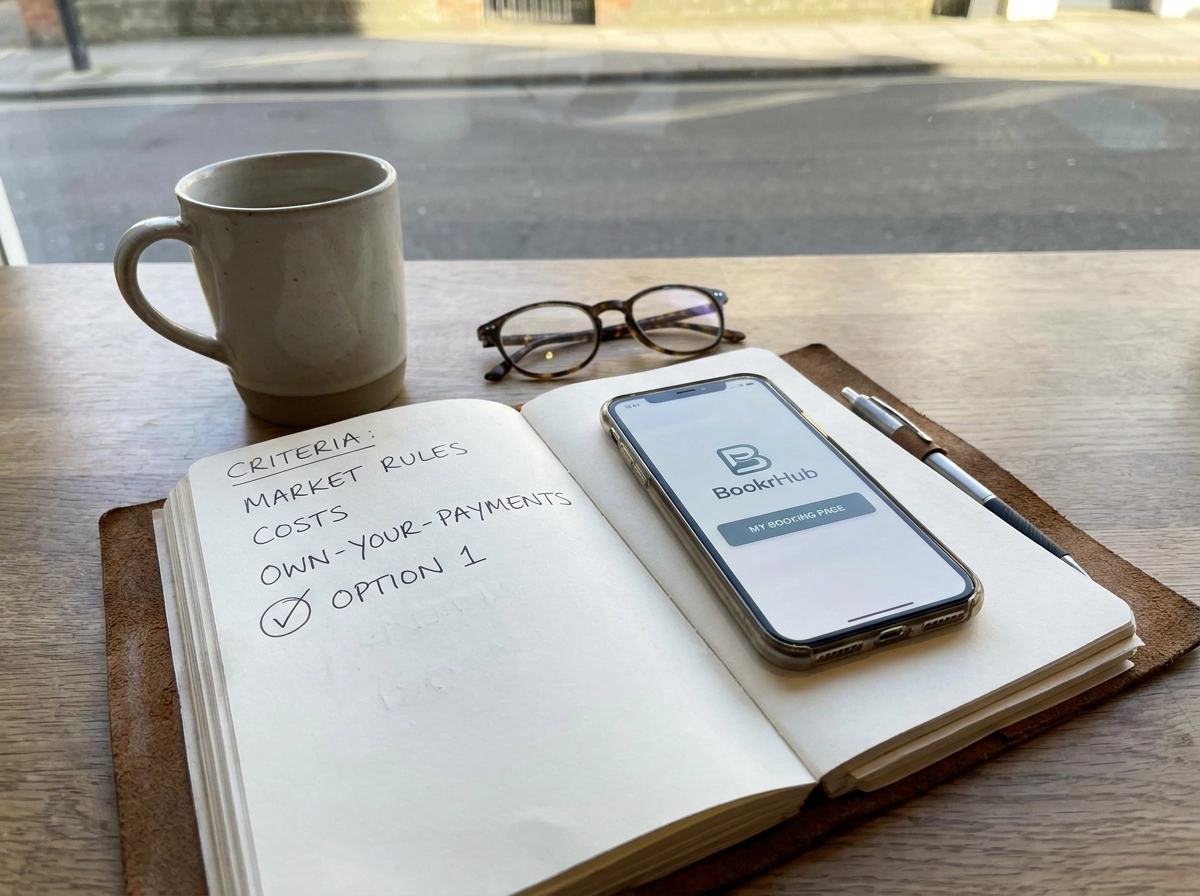
Once you know how your market's rules shape real costs, it helps to see how one platform applies the own-your-payments model. That is where BookrHub sits: one option among the criteria above, not the only answer.
BookrHub is built around your own payment account. Clients book on your branded page and payments land in your own Stripe or Mercado Pago account, with zero commission on the platform side. Processor fees still apply, and supported processors and countries change, so confirm the current list on bookrhub.com for your market.
Each business gets a branded booking page that can work as its whole website, which saves solo operators paying for and maintaining a separate site.
Clients pick a service, a staff member and a time slot that updates live against your opening hours, buffers and existing bookings. Double-booking is designed out, not cleaned up afterwards. Clients reschedule or cancel on their own, and email reminders go out automatically, so you are not chasing people on WhatsApp.
Team, calendar and blackout dates are managed from a web dashboard plus iOS and Android apps, handy when you run things from your phone between clients.
Be honest about fit. If you want marketplace discovery or rely on SMS reminders and deep accounting integrations, weigh those gaps first. Our Frequently Asked Questions cover the rest.
Questions Owners Ask Before They Switch
BookrHub charges no platform commission; your payment processor (Stripe or Mercado Pago) charges its standard card-processing fee.
Regarding deposits and cancellation policies, these are governed by your local consumer and privacy law. You must set them carefully and disclose them clearly after checking your state or country's requirements. Furthermore, while automated reminders help reduce no-shows, the published evidence confirms they do not eliminate them; always measure your own business improvement.
From a technical standpoint, you can keep your existing website, using our branded booking page to sit alongside it or function as your sole online presence. For international operations, such as running a business in Latin America, confirming local currency support, Spanish-language client pages, and Mercado Pago availability is vital. For detailed advice on setting up your system, check our Frequently Asked Questions.
Your Five-Minute Decision Framework
With the full picture of fees, payouts and niche fit in hand, here is how to make the call in five minutes:
Choose the system that fits your niche. Barbers need live calendar buffers; cleaners need custom travel time allowances; beauty businesses need automated deposit options. Run a two-week trial with a live card payment, the actual fee deducted and payout timing tell you more than any comparison table. Then commit to an annual review, because fee structures and local rules shift and the platform that works today needs to keep working as you grow.
Conclusion
Navigating the world of booking platforms requires moving past marketing promises and getting into the fine print. The truth is, "commission-free" is only part of the story. Your success depends on understanding the total cost structure, including hidden fixed charges, and ensuring the platform truly aligns with your unique business niche. Before signing any contract, perform your due diligence: request a complete fee schedule and run a real-world trial.
The ultimate goal is not simply to find the cheapest price, but to find the most profitable partner, one that gives you control, transparency, and room to grow. Take control of your operations today. Start by modeling your own costs and finding the booking solution that empowers your business growth.